World Cup 2026: Didier Deschamps finding balance in France's superstar squad
Didier Deschamps is successfully adapting his tactical system mid-tournament to maximize France's elite attacking talent at the World Cup.
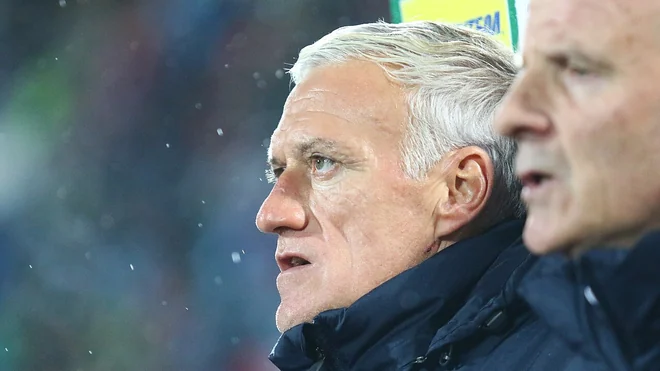
Photo: Wikimedia Commons / CC BY-SA 2.0 / Author: Biser Todorov ( User:Biso ) from Sofia, Bulgaria
Managing a star-studded squad like France's is often viewed as a simple task, but history suggests otherwise. Didier Deschamps, in charge since 2012, has once again proven his ability to reinvent his side mid-tournament, focusing on creating conditions that maximize his players' individual strengths rather than sticking to rigid patterns.
The central challenge for Deschamps at this World Cup has been accommodating Kylian Mbappe as a number nine. The initial system, resembling a lopsided 4-2-4 or 4-2-3-1, aimed to mirror players' club roles. However, the opening match against Senegal exposed friction, with significant gaps between the attacking line and the midfield duo causing defensive vulnerability.
Deschamps responded decisively at half-time, swapping the roles of Ousmane Dembele and Michael Olise. By moving Dembele to the right of midfield, France shifted into a more compact 4-4-1-1 off the ball, providing better protection for the central midfielders. Simultaneously, Olise's move into a central role has allowed him to better facilitate Mbappe with threaded passes.
These adjustments have resulted in a more threatening and stable French side. While the team retains the fluidity that allows players like Bradley Barcola and Desire Doue to rotate across the forward line, the tactical stability has improved significantly. Deschamps' willingness to prioritize player skill-sets over systems continues to be a defining characteristic of his management.