The most effective attacking run at this World Cup and why it works
FIFA performance data reveals that inside-channel runs are significantly increasing goal-scoring opportunities at the 2026 World Cup.
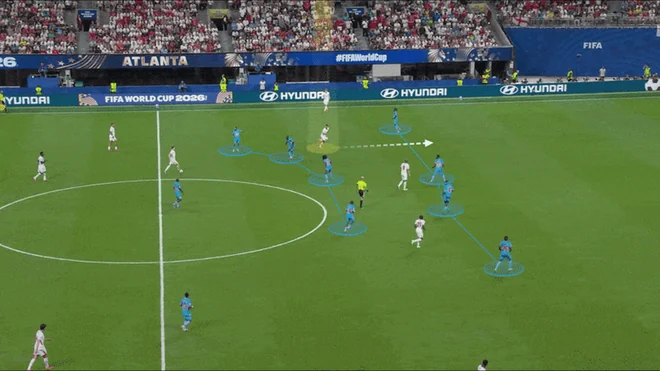
At the 2026 World Cup, FIFA’s Football Performance Insights team has identified a major tactical trend: off-ball runs targeting the inside channels — the space between a wide defender and the nearest centre-back — are becoming a primary attacking threat. Compared to the previous tournament, possession sequences featuring this movement now yield around 2.7 shots on goal per 30 minutes, an increase of roughly 34 per cent.
These runs work by forcing immediate defensive dilemmas. When an attacker cuts through that gap, the full-back and centre-back must decide in a split second who tracks the run. This hesitation allows the attacking player to gain a vital advantage in momentum and space.
Former Denmark striker and FIFA technical expert Jon Dahl Tomasson notes that even when the runner isn't found with a pass, the movement disrupts the defensive shape. A prime example occurred during England’s match against DR Congo, where Jude Bellingham’s run dragged a central defender out of position, creating space for Harry Kane to score the winner.
Research across the 48 participating teams shows that possession sequences containing an inside-channel run produce over double the expected goals (xG) per sequence. Shots occur 13.3 per cent of the time following such a run, compared to just 5.9 per cent without, highlighting that players with the vision to exploit these gaps are essential for breaking down compact, deep-sitting defenses.