Five Tactical Lessons From the 2026 World Cup That Could Shape Club Football
Using FIFA's analysis of 104 matches, we explore five tactical trends from the 2026 World Cup and what they mean for club football.
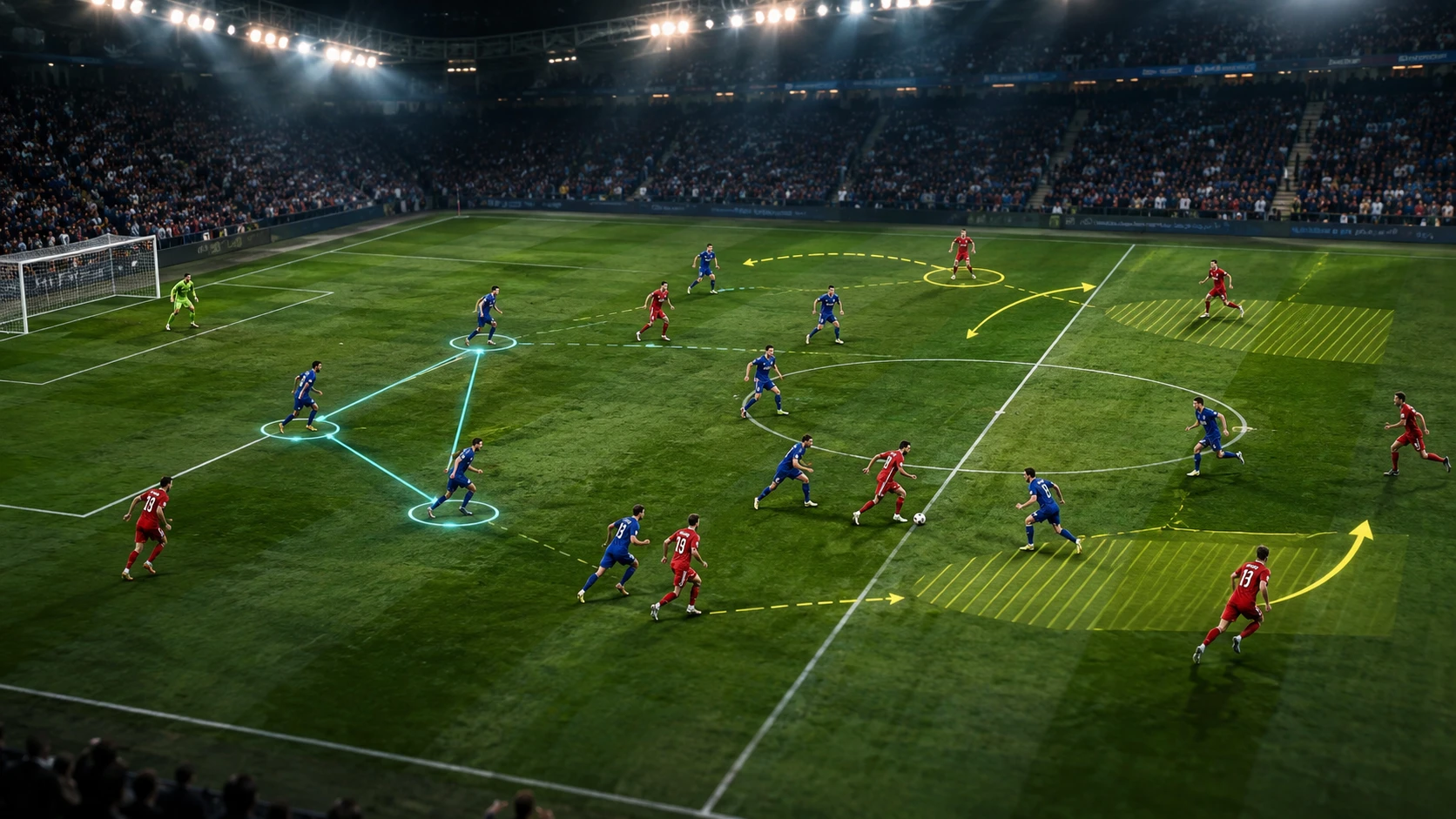
AI-generated original illustration
Spain won the 2026 World Cup, but the tournament's tactical legacy extends beyond the final result. FIFA's Technical Study Group and Football Performance Insights analysed all 104 matches, identifying nine areas for detailed study. We selected five that offer particularly useful lessons for club football. These concepts were not invented in 2026; the World Cup showed how established principles work across different teams and football cultures.
1. Counter-pressing starts before possession is lost
After losing the ball, a team can retreat or immediately pressure the opponent. FIFA identified the second approach, counter-pressing, as one of the tournament's defining trends. Champions Spain were especially effective at using their in-possession structure to regain the ball before opponents could reorganise. FIFA's technical report describes how turnovers could become immediate attacking opportunities.
Intensity alone is not enough. If midfielders are already positioned close to the ball while attacking, they can block short passing options as soon as possession changes. If the team is stretched, one pass can bypass the pressure. Effective counter-pressing therefore begins with positioning before the turnover. For clubs, this means assessing an attacking shape not only by the chances it creates, but also by the protection it offers against counterattacks.
2. Goalkeepers change the numbers in build-up
The modern goalkeeper does more than play the first pass. By joining the build-up, the goalkeeper creates an extra passing option and forces the opposition to decide whom to press. If a forward closes down the keeper, a defender may become free; if the forward stays back, the goalkeeper gains time to distribute. FIFA highlighted the increasing importance of goalkeepers in beating pressure.
Short passing, however, is not an end in itself. A mistake near one's own goal carries an enormous cost. The crucial skill is decision-making: recognising when to combine with defenders and when a longer pass is safer. This changes how clubs train goalkeepers and coordinate them with the defensive line.
3. A back three in possession is not necessarily the starting formation
A side may line up in a 4-3-3 and still build attacks with three players across its first line. One full-back can move inside while the other advances. Such movements create passing angles and can help manage space if the ball is lost. FIFA devoted a separate tactical study to building with a back three.
Three players behind the ball do not automatically prevent counters: spacing and reactions matter. A single formation graphic cannot explain a team's actual tactical behaviour. Build-up, high pressing and deep defending may each involve different structures. That increases the value of versatile players who can change responsibilities without a substitution.
4. Inside channels force defenders into difficult choices
The spaces between central and wide areas, often called half-spaces, were another focus of FIFA's research. A player receiving between a full-back and a centre-back presents a dilemma: step out and leave room behind, or hold position and allow the receiver to turn.
The advantage depends on coordinated movement. One player stretches the back line wide, another occupies the space between the lines and a third runs behind. Even players who never touch the ball can reshape the defence. Space is often created by the receiver's teammates rather than the receiver. For clubs, that makes synchronised off-ball movement as important to train as individual dribbling.
5. There is no single winning tactical formula
FIFA's report contrasts high pressing, compact low blocks and fast attacking transitions. Cabo Verde is highlighted as an example of how organised defending and proactive goalkeeper involvement can help a team compete against technically superior opponents.
High pressing can recover possession near the opposition goal, but it leaves space behind the press. A low block protects central danger areas, yet may surrender possession for long periods. The best system is the one suited to the players available. Copying a World Cup winner's shape without accounting for a club's squad is not a shortcut to success.
What does this mean for club football?
National teams have far less training time than clubs and must choose tactical mechanisms they can implement quickly. Club coaches can develop more complex relationships over an entire season. That is why the World Cup findings are better understood as principles to test than as instructions to copy.
The future does not belong to one formation. It belongs to teams that can connect build-up, protection against transitions, use of inside channels and adaptation to opponents. The central lesson of the 2026 World Cup is not a new system but the relationship between every phase of play.