Argentina Without Messi: Why 72% Possession Was Not Enough Against Uruguay — and Who Leads Next
Argentina dominated the ball but lost 2-1 to Uruguay in its first game after Messi. What does the result reveal about Nico Paz and Scaloni’s next attack?
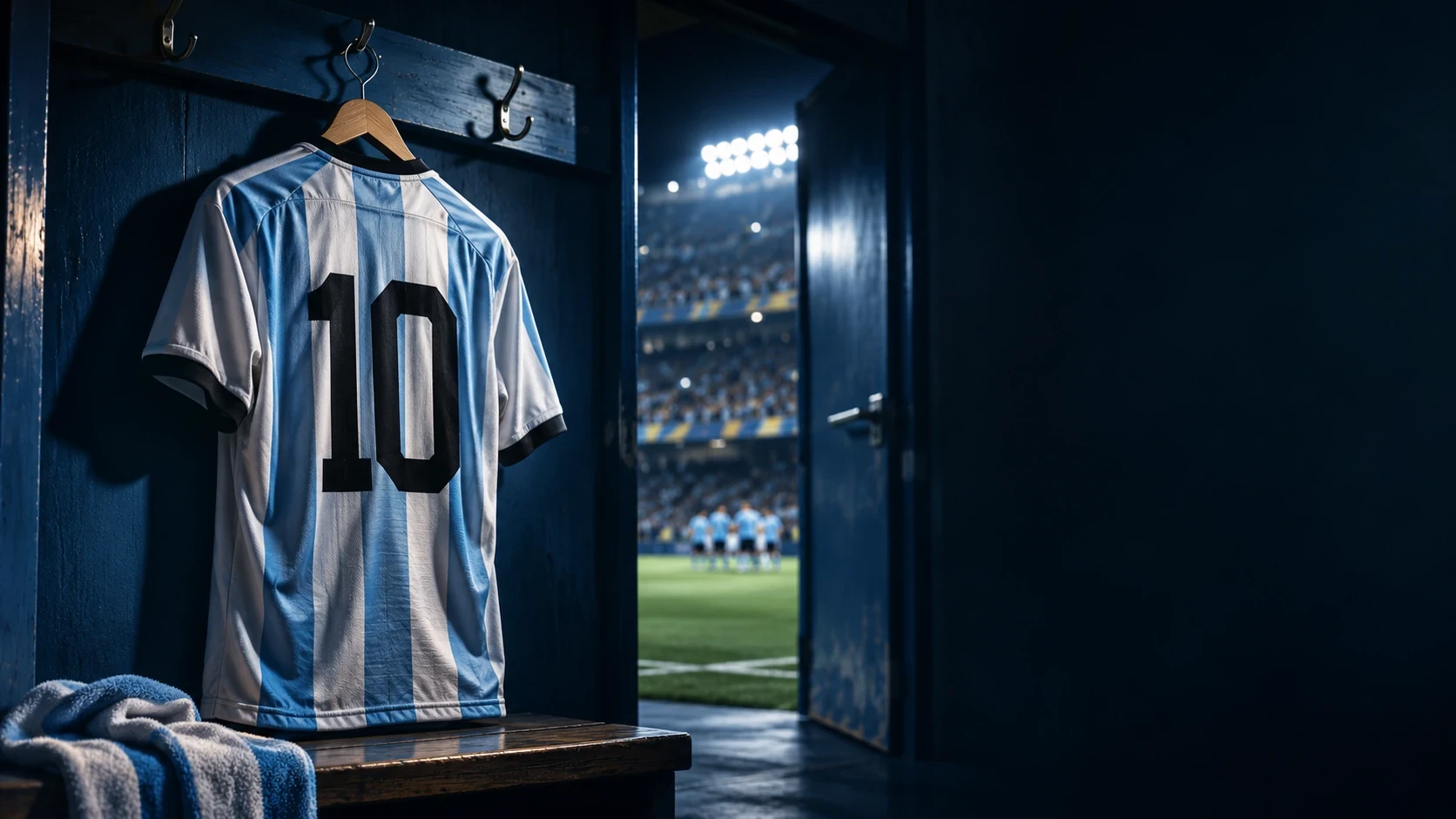
AI-generated editorial illustration. Not a photograph of the November 13 match.
Seventeen shots, 72% possession and only one goal. Argentina’s first match since Lionel Messi retired from international football ended in a 2–1 defeat to Uruguay on 13 November 2026. But the numbers from La Bombonera tell a more revealing story than simply the absence of the iconic No. 10.
Lionel Scaloni’s side had more of the ball, took far more shots and spent longer in attacking areas. Yet two goals within five minutes of the second-half restart forced Argentina to chase the game. Uruguay held on despite Julián Álvarez pulling one back.
The first serious test of the post-Messi era raises a question that goes beyond who inherits his shirt: how can Argentina distribute the jobs Messi used to perform among several players?
The paradox of 72% possession
The final statistics underline the difference between controlling the ball and creating decisive chances:
- Possession: Argentina 72%, Uruguay 28%.
- Shots: Argentina 17, Uruguay 6.
- Expected goals (xG): Argentina 1.32, Uruguay 0.38.
- Big chances: Argentina 2, Uruguay 1.
- Touches in the opposition box: Argentina 28, Uruguay 8.
- Final score: Argentina 1, Uruguay 2.
Source: Flashscore match statistics, 13 November 2026. xG is an estimate and can vary between data providers.
Argentina shot almost three times as often and reached the penalty area much more frequently. However, those 17 attempts produced only two chances classified as big opportunities. Their 1.32 xG indicates pressure without a sustained stream of clear-cut openings.
Uruguay, meanwhile, scored from two unusual sequences rather than long spells of attacking dominance: Leonardo Balerdi diverted the ball into his own net, and Maximiliano Araújo benefited from a deflection following a corner.
Argentina controlled much of the match, but not the scoreline. Equally, Uruguay’s low xG is a reminder not to mistake the result for proof that the visitors had complete tactical superiority. Own goals and deflections can swing a single game.
The five minutes that changed the match
The opening half suggested that Argentina could still dictate territory without Messi, but also showed the limits of their possession game. At the interval, they had around 66% of the ball and six attempts, yet their first-half xG stood at just 0.25.
Scaloni sought a different attacking dynamic at the break, sending on Matías Soulé for Exequiel Palacios. Almost immediately, though, Uruguay struck.
In the 48th minute, Lisandro Martínez tried to clear Giorgian de Arrascaeta’s delivery and the ball rebounded off Balerdi into Argentina’s goal. Five minutes later, De Arrascaeta’s corner glanced off Araújo and looped in for 2–0.
Argentina now needed its possession to produce goals, not merely control the rhythm. Gianluca Prestianni replaced Thiago Almada around the hour mark, giving the hosts another direct option on the flank.
That change helped produce the response. On 73 minutes, Prestianni drove forward and cut the ball back for Álvarez to finish. It was a telling move: the goal came from progression, movement and a well-timed cutback, rather than another long passing sequence around the penalty area.
One assist is not enough to declare Prestianni the solution to Argentina’s attacking problems. It does, however, illustrate another way of creating danger when opponents crowd central spaces.
What Argentina actually lost with Messi
Messi’s departure created more than one vacancy. Across his international career, he combined several roles: playmaker, ball-carrier between defensive lines, provider of the final pass and scorer capable of changing a match with one action.
Defenders faced a recurring dilemma. Step out to close him down, and they risked leaving space behind. Stay in position, and they could allow him to receive the ball facing goal. Few players can reproduce all those effects by themselves.
For Argentina, rebuilding the attack means solving three connected problems.
First: move the ball into dangerous central spaces. Midfield possession becomes threatening when a pass breaks an opponent’s line, not simply when another pass is completed.
Second: create an advantage near the penalty area. Someone has to receive under pressure, turn, beat a defender or deliver a pass that changes the shape of the defence.
Third: turn progression into shots worth taking. Even promising moves achieve little when forwards receive with their backs to goal or settle for low-probability attempts.
The coaching challenge is therefore not to find a replica of Messi. It is to design a system in which several specialists complement each other.
Nico Paz, Almada and the young wingers: who can shape the next attack?
Nico Paz: the clearest candidate to orchestrate play
The 22-year-old Como midfielder is arguably Argentina’s most natural long-term option for a central creative role. He is comfortable receiving between the lines, has the technique to operate in tight spaces and can play passes that move an attack forward.
Regular football at Como under Cesc Fàbregas gives him an especially interesting development environment: one that places a premium on positioning, combinations and decision-making under pressure.
Paz started against Uruguay and registered three shots, but Argentina did not yet get the consistent final-third influence it needs from a central creator. That should not be treated as a personal failure in a single friendly.
His best role may be the connection between the deeper midfielders and Argentina’s forwards, rather than an imitation of Messi. To make that work, Scaloni needs coordinated movement around him and more opportunities to receive in dangerous pockets.
Thiago Almada: movement and combinations
Almada offers a different set of qualities. He can drift between wide and central areas, support quick combinations and help the team carry attacks into advanced positions.
That flexibility could allow Scaloni to share creative responsibility. Paz might focus on passes through the centre while Almada moves across the left or into the half-spaces to create overloads.
The Uruguay game nevertheless showed that simply selecting two technically gifted players does not guarantee incision. Their movement must fit together. If both drop deep to ask for the ball, there may be too few runners ahead of them.
Matías Soulé and Gianluca Prestianni: a different route to goal
Perhaps Scaloni’s biggest decision is not which player becomes the new No. 10, but how much responsibility to give to wingers who can make the attack more direct.
Soulé and Prestianni can change the direction of play, attack defenders one-on-one and deliver the ball before an opposing back line has time to reset. Prestianni’s assist for Álvarez is one concrete example of the potential value of that approach.
But the proper test will be repeatability: can either player regularly create dangerous situations against organised defences, rather than merely deliver one excellent moment?
Three ways Scaloni could rebuild Argentina
1. Build the attack around Nico Paz
Argentina could retain a recognisable central playmaker while creating a more mobile structure around him. Deeper midfielders would help supply the ball; wide players would make runs behind defenders and stretch the pitch.
The appeal is clarity. The risk is placing too much expectation on a young player who is still learning the international game.
2. Share creativity across the midfield
Paz, Almada, Enzo Fernández and Alexis Mac Allister could divide responsibility for progressing the ball and constructing chances. With several sources of creativity, opponents would find it harder to close every passing lane.
The danger is that a technically accomplished side becomes comfortable circulating the ball without accelerating at the right moment. Movement into the box must accompany the passing.
3. Make the attack more vertical
A more direct Argentina would look to exploit space earlier, bring the wingers into the game more often and deliver the ball to Julián Álvarez in dangerous positions.
This approach could reduce dependence on prolonged positional attacks. It would also require good protection behind the ball: faster attacks can expose a team if possession is lost and the midfield is too far away to react.
The most promising route may combine the second and third ideas: shared responsibility for creating attacks, plus the ability to increase the tempo and go forward quickly.
Costa Rica: the next test, not a final verdict
Argentina are scheduled to face Costa Rica in Córdoba on 17 November. The friendly offers another opportunity to examine Scaloni’s new combinations.
A win or an improved shot count would not be enough by themselves to show progress. More useful questions are:
- How often do passes reach players between the opponent’s midfield and defence?
- Are Argentina generating more clear chances rather than merely taking more shots?
- How much do Paz and the other attacking midfielders contribute to creating opportunities?
- How quickly does controlled possession become a dangerous move?
- How effectively does the team defend after losing the ball and from set pieces?
The number that matters most may not be possession, but how often Argentina turn their territorial advantage into high-quality chances.
Argentina do not need to find another Messi
Before facing Uruguay, Scaloni left the No. 10 shirt unassigned. It was a symbolic choice that reflected a real uncertainty: there is no obvious single successor to a player who defined an era.
But the shirt should not dictate the plan. Argentina remain capable of controlling matches, and their loss to Uruguay — shaped by an own goal and a deflected corner — is not evidence of an irreversible crisis.
The challenge is to make possession more purposeful. Paz can grow into a central creative role; Almada, Soulé and Prestianni can offer variety; Enzo Fernández and Mac Allister can provide a platform from deeper positions.
Argentina’s next era will not be decided by who wears the No. 10. It will be decided by whether eleven players can create together what one extraordinary player once so often made possible.
Sources: Flashscore, EFE, Associated Press, Como 1907.